
Exactly how rich is the President of the People’s Republic of China? According to an April 2024 Congressional Research Service report based on public records: “Xi Jinping holds an estimated hidden wealth of $700 million.” But wait. Nobody really knows if this is correct. Other published estimates place Xi’s total worth as high as $1.2 billion or as low as $1 million.
That’s quite a range: the highest of these three estimates is 120,000 times larger than the lowest. What’s behind this enormous disagreement? Secrecy.
The estimates above refer to family wealth, not personal wealth. That’s because in China, “generally the big corruption does not happen with the officials themselves, but with relatives of officials. Just being related to a big-wig means that people will throw money at you.” Then add the fact that “Much of the family’s wealth remains unclear and untallied because of the absence of Chinese corporate and real estate disclosure rules, as well as a propaganda system that bans media discussion of leaders’ personal details and removes them from the internet.”
For example, around the time Xi first became China’s President, Bloomberg News journalist Michael Forsythe published an expose regarding Xi’s wealth. Soon after “Forsythe and his family received death threats, and Bloomberg’s site was blocked within [China].” This intimidation worked. As a result of the reaction to Forsythe’s piece, “Bloomberg declined to publish a subsequent investigation…”
Despite the difficulty of coming up with a reliable total figure, it is very clear that Xi lives a VERY comfortable life, including:
- For long distance travel, Xi Jinping uses a “customized Boeing 747” – known as Air China One.
- For local travel, Xi has an “armored limousine created specifically for him by the Chinese luxury Vehicle Manufacturer Hong Chi.”
- While Xi’s official residence has not been “officially disclosed,” as China’s leader, Xi “has access to multiple opulent and historically significant mansions.”
- The best known of these residences is the Zhongnanhai leadership compound in central Beijing. Zhongnanhai is a “1,500-acre site of repurposed imperial pavilions and temples… [which] has formed the leadership compound for the ruling Chinese Communist Party since 1950.” That’s right. The leader of the largest Communist nation on Earth lives right next door to the Forbidden City, home to “24 Ming and Qing dynasty Emperors… from 1420 to 1924.”
- Much of the time, Xi resides on Ying Thai Island in a 2.5 acre estate on Zhongnanhai. More specifically, China’s proletarian leader resides in a 19 room mansion that was “formerly a summer retreat for Emperors and concubines.”
Also note that in China, “for very high ranking officials [in China], all things for their entire life are provided by the government… [and they] do not have much opportunity to use their own money” for living expenses. But the world is full of luxuries and many Chinese leaders and their families don’t seem to have trouble finding things to spend their excess money on.
Some examples can be seen in a Twitter account started in 2022 by Xi’s only child — his 32 year old daughter Xi Mingze (nicknamed Xiao Muzi) — showcasing her lavish lifestyle including:
- A Van Cleef & Arpels’ bracelet valued at over $135 thousand (US)
- A custom Patek Philippe diamond watch worth $1 million (US). (Normally, this particular watch is reserved for VIPs who spend over $5 million annually on this brand.)
- A customized Rolls-Royce Cullinan worth $28 million (US)
- $100 million (US) mansion in Hong Kong
- And much more
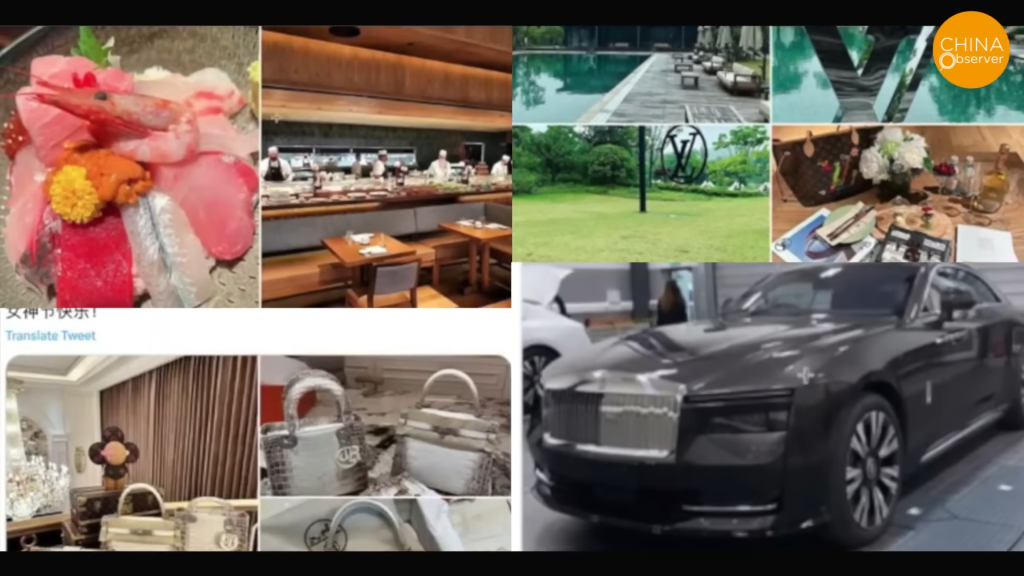
But Xi Mingze’s posts on luxuries ended “on September 25th 2023 when her Twitter account was exposed by Luda media.” As a result, Xi Mingze “allegedly [issued] a death threat against Luda media indicating that any harm coming to the media network would be her family’s doing.”
Some US politicians seem to believe that if the facts become available “about the enormous wealth of individual leaders of the CCP, the Chinese people will turn China into a respected democracy like Taiwan.”
For example, “Sen. Marco Rubio inserted language into… the 2023 National Defense Authorization Act… which required the US Director of National Intelligence to produce a ‘Report on the Wealth and Corrupt Activities of the Leadership of the CCP’” by December 2023. The report would investigate not just “Xi Jinping… [but also] other members of the Central Committee, the Politburo, the Politburo Standing Committee, and regional Party Secretaries.”
Interestingly, as of the date of this post — 10 months after the publication deadline had passed — the report yet to be published. My personal guess is that Avril Hines – Director of National Intelligence – is slow walking the report, at least until after the Presidential election.
If all of the info on Communist leaders’ wealth was fully vetted by US intelligence, and released as part of a well-thought out strategy to manage the contentious US-China relationship, perhaps it might make a difference. But in this case it feels more like an isolated action poking Xi Jinping in the eye with a stick, to show the world that we’re right and he’s wrong. In my opinion, Cruz and his allies range from naïve to downright stupid if they really think that such a report would convince Chinese citizens that they would be better off in a Taiwan-style democracy.
When (or if) this report is published, it will almost certainly prove that Xi is just one of many leaders who live luxurious lifestyles on the backs of the Chinese people. In fact, Xi’s offenses are likely to be relatively modest compared to some others. Since coming to power in 2012, Xi has focused on anti-corruption campaigns and earlier this year, he vowed to intensify this campaign and “target industries such as finance, energy and infrastructure.”
Corruption is a long-standing tradition in China, going back thousands of years, at least to Qin Shi Huang, the first Chinese emperor in 259 BCE.
After the Chinese Communist Party won its revolution in 1949, many Party leaders lived the high life. Numerous examples appear in the controversial book “The Private Life of Chairman Mao,” written by Mao’s long-term personal physician Li Zhisui, including:
- “Luxuries not even imaginable to the Chinese citizenry, [such as] owning numerous estates, and having numerous extramarital affairs with very young women and even boys”
- “Like Chinese emperors of antiquity, Mao believed that regular sex ensured a long life and had at least 3,000 concubines over his lifetime… He aimed to have sex with a different virgin girl every night.
- He was also “a gourmet… [whose] favorite foods were flown to Beijing from all over the country, including a special kind of fish [that needed to be] kept alive in a plastic bag filled with water and accompanied by a servant responsible for administering oxygen.
I don’t know about you, but it feels more than a little odd to me that the heads of the largest Communist nation on Earth would have access to privileges denied China’s 1.4 billion residents.
When Karl Marx and Friedrich Engels published the Communist Manifesto in 1848, they focused on “the exploitation of the proletariat (working class of wage laborers) by the ruling bourgeoisie.” They did not mention the possibility that the success of the Communist Party could create a new class of leaders who would exploit the proletariat.
In 1887, English historian Lord Acton wrote “Power tends to corrupt, and absolute power corrupts absolutely.” It’s still true.
So, in my opinion, the fact that many of China’s leaders are rich while more than a billion of its citizens are poor is not surprising. The fundamental causes lie not in communism or in capitalism, but in human nature.
The possible role of human nature in inequality will be the basis for a number of posts in my soon to be updated “other blog”: Understanding US economic inequality, five minutes at a time.


 Understanding China, five minutes at a time