Taiwanese TV drama envisions war with China

Two weeks ago, a Taiwanese TV station released a trailer for “Zero Day,” a dramatic series about a fictional war with China.  It has already been viewed over 1.4 million times on YouTube.

The preview presents a rich and riveting view of the steps leading to war.  The details are so realistic that a YouTube commenter from the Ukraine described one scene as “Exactly what happened at my home … in Kharkiv… when Russia attacked.” 

The ten-episode series says little about how or even whether the US gets involved.  Instead, it imagines events within Taiwan during the seven days leading up to war. Characters in the drama respond to the threats in a variety of ways, including fight, flight, and utter confusion.

In one scene, a fictional social media influencer urges her countrymen to side with China, as shown below:

A fictional Taiwanese social media influencer in the TV series “Zero Day” says “Taiwanese people shouldn’t fight their own people…You think we could win?  We know we can’t.  That’s why we’re so afraid.  Those who ask you to go to the battlefield… they don’t give a shit about our suffering.”

Several other scenes show criminals being released from Taiwanese prisons at the behest of China, since “China has long been infiltrating the underworld and social organizations.”  They immediately begin committing crimes which contribute to the chaos and magnify social unrest.

This 17-minute trailer (in Mandarin with English subtitles) begins when a PLA (People’s Liberation Army of China) Y-8 military transport “mysteriously disappears” from radar near Taiwan.  China imposes a naval blockade on the island, under the pretext of a search and rescue operation.  Within a few days, all international shipping has been blocked from the Taiwan Strait, Taiwan’s stock market has cratered, there’s been a run on the banks, ATMs have stopped working, and the US and other countries have begun trying to evacuate their citizens from Taiwan.

Chaos continues to grow.  Four days before the war begins, according to the film, “Hacker attacks and spy sabotages have led to random water, power and internet disruptions.”  The Prime Minister of Taiwan then gives a national address about the need to defend the country, saying “Without freedom Taiwan is not Taiwan.”  But midway through the speech, the TV broadcast is hacked and an AI deepfake of the Prime Minister declares war on China.  The hacked broadcast then switches to an announcer in China, who says “The PLA guarantees all Taiwanese people will be fully protected… When you encounter a PLA soldier, first raise your hands high to show you are not armed… Second, please report to the PLA if you know any hidden pro-independence activists.”

The final day before war begins is described by the film as “Total chaos… [including] shortages of supplies, complete interruption of water, electricity and telecommunications.  The fleeing starts.” The preview ends the day war begins, with an ambiguous picture of armed soldiers hiding in a field in Taiwan. 

If you want to know what happens next in the TV series, you will have to wait for it to be released in Taiwan in 2025.  You may even be able to see it in English; according to CNN “the production team is… in the early stages… of discussions with streaming services including Netflix for a potential international release.”

This is the first TV series in Taiwanese history to dramatize a Chinese invasion. It is scheduled to finish production in November and go on Taiwanese TV sometime in 2025.  The film is highly professional, and even inserts some humor into tragic situations.  For example, while helping her husband pack to flee Taiwan, one young woman says in amazement “We are running for our lives here, and you are packing condoms?”  His answer: “Maybe we’ll need them when we get bored.”

When CNN interviewed producer Hsin-mei Cheng about the series, she said she was “worried that her fellow Taiwan citizens have grown ‘too numb’ to the danger of an impending conflict… I hope the show can serve as a wakeup call to the Taiwanese people: what should we do when we still have the right to choose?”

There is no issue that is more important to US-China relations, and maybe to the fate of the planet, than the future of Taiwan.  I have described the background in three previous posts:  in 2021 (The Taiwan Conundrum), 2022 (The sheer stupidity of Nancy Pelosi’s trip to Taiwan) and 2023 (Is war over Taiwan inevitable?).  My main conclusions were:

1) Since Communists took control of the mainland in 1949, they have been extremely consistent and emphatic about their plans to make Taiwan part of China.  As Xi Jinping stated a few months ago in his New Year’s Eve address to the nation, “The reunification of the motherland is a historical inevitability.”

2) When it comes to responding to an invasion of Taiwan, the US has a policy of “strategic ambiguity.”  Under this purposely vague policy, the US strongly supports Taiwan both politically and militarily, but does not guarantee that it will help defend Taiwan if it is attacked.

    In the 15 months since my most recent post on Taiwan, things have only gotten worse.  On May 20, Lai Ching-te was inaugurated President of Taiwan.  When Lai was Premier of Taiwan, he had “made headlines in 2017 by describing himself as ‘without a doubt… a politician who supports Taiwanese independence’ and [also said that he would] never change this stance, no matter what office I hold.’”

    However, like almost every politician in the history of the world, Lai later changed his mind to get more votes.  Although he has “shifted his stance on Taiwan’s independence multiple times,” China still “considers Lai a dangerous separatist.”

    The Institute for the Study of War publishes a “China-Taiwan Weekly Update” to report on military and political tensions, including incursions by Chinese military aircraft into the Air Defense Identification Zone (ADIZ), an area over and around the island. According to their most recent update (published on August 2):  “The PRC conducted at least 439 military incursions into Taiwan’s Air Defense Identification Zone in July 2024, surpassing all previous months except August 2022… [when China] conducted… massive military exercises in response to then-US House Speaker Nancy Pelosi’s visit to Taiwan… July [was] the third consecutive month of significantly higher and rising numbers of ADIZ incursions… [since]Lai Ching-te took over.”

    In response, “Taiwan’s government has been trying to improve its defenses by extending mandatory military service and revamping ongoing training for reservists as part of a broader shift in defense strategy designed to make Xi think twice before taking a gamble on use of force.”

    No one in China or Taiwan or the US knows when or even if China will act to take over the island it considers a rightful part of its nation. 

    I believe that Xi Jinping will continue to stand by a statement he has often repeated from former Chinese president Jiang Zemin that “Chinese will not fight Chinese.”  I have no doubt that China will one day achieve its goal of reunifying with Taiwan, almost certainly before the Communist government’s 100th anniversary in 2049.  But I also believe they will wait for a relatively peaceful opportunity, act suddenly, and avoid the catastrophes depicted in “Zero Day.”
    Is war over Taiwan inevitable?

    There is an enormous amount of controversy about if and when China will invade Taiwan. “In one recent poll… of top specialists on China… 63 percent of respondents believed an invasion to be ‘possible within the next 10 years.’”  Note that this survey did not ask whether it was probable, just whether it was possible.  So, by implication, over a third of this group of experts (the remaining 37%) thought that invasion was NOT POSSIBLE in the next decade.

    While many experts do think an invasion is coming, they disagree strongly about when.  At one extreme, Air Force Gen. Mike Minihan was in the headlines a few months ago when he a released a memo arguing “that China cannot be deterred from invading Taiwan.  ‘My gut tells me we will fight in 2025.’”   At the other extreme, many point to 2049 as the final deadline, since it’s the 100th anniversary of the Chinese Communist Revolution.   

    Still, if current threats to world-wide peace could be ranked, Taiwan would probably be #2, just behind the Ukraine.  The basic issues of the conflict have remained the same since I wrote my 2021 post on “The Taiwan Conundrum.” What’s changed in the last two years is that the temperature has gone up.

    A Taiwan-China war is harder to predict than most conflicts for two reasons.  The first is the lack of transparency into Chinese politics, making it hard to define the gap between what Chinese politicians say, and what they may actually do.  The second is the United States’ longstanding policy of “strategic ambiguity.” Under this purposely vague policy, the US strongly supports Taiwan both politically and militarily, but does not guarantee that it will help defend Taiwan if it is attacked.

    In contrast, there can be no doubt about China’s long-term intentions.  At the 20th National Congress of the Chinese Communist Party last October, the 2,300 delegates voted to add these words to the Party Constitution: “resolving the Taiwan issue and achieving the complete reunification of the motherland is a historical task to which the Chinese Communist Party will never relent.”

    So the key question is not about China’s goal, but rather about whether it will lead to war.  Some Taiwanese political parties favor a peaceful re-unification with the mainland.  However, their popularity declined dramatically a few years ago, after Hong Kong’s freedoms were slashed when the island was forcefully taken over by Beijing. 

    Still, as Kevin Rudd wrote in his excellent book The Avoidable War (Kindle loc 1318):  “Xi’s objective is to secure China’s territorial claims in… Taiwan without ever having to fire a shot.”  Similarly, a recent CNN article put it this way: “The Chinese are going to do everything they can… to avoid a military conflict with anybody… To challenge the United States for global dominance, they’ll use industrial and economic power instead of military force.”

    Let’s hope CNN is right on this one, because if the US and China ever do go to war, the effects would fall somewhere between disastrous and the end of the world.

    In January, The Center for Strategic and International Studies (CSIS) released a fascinating white paper with the ominous title The First Battle of the Next War.  It summarizes the results of 24 elaborate war games that simulated a Chinese amphibious assault of Taiwan, with the US and Japan coming to its defense.  The headline conclusion was “China is unlikely to succeed in an invasion of Taiwan in 2026.” (p. 83)  But the cost is extremely high to both sides.  China would suffer tens of thousands of casualties, plus similar numbers of prisoners of war, and its navy would be left “in shambles.” (p. 3)

    Taiwan would suffer even more.  “While Taiwan’s military [would be] unbroken, it [would be] severely degraded and left to defend a damaged economy on an island without electricity and basic services.” (p. 83) As a result, Taiwan’s economy would be crippled for years.

    Finally, the report concluded, “The United States might win a pyrrhic victory, suffering more in the long run than the ‘defeated’ Chinese… In three weeks, the US would suffer about half as many casualties as it did in 20 years of war in Iraq and Afghanistan.” (p. 4)  We would also lose dozens of ships and hundreds of aircraft. 

    Given that both sides would prefer not to fight, at least in the next few years, what could spark a US-China war?  Grandstanding politicians.  For the most prominent recent example, see the post I wrote last year entitled “The Sheer Stupidity of Nancy Pelosi’s visit to Taiwan.”  In August, while still Speaker of the House of Representatives, Pelosi became the first speaker to visit Taiwan since Newt Gingrich toured the island in 1997.  In a Washington Post op-ed, Pelosi described the purpose of her visit as “reaffirming that the freedoms of Taiwan — and all democracies — must be respected.”

    China considered this an insulting and hostile act, and responded by “holding its largest military drills in decades and, in a first, sending a missile over the island.”  The Taiwanese public weren’t exactly grateful for the trip, they were scared by it.  Taiwanese surveys conducted soon after the visit found that “respondents overwhelmingly believed that Pelosi’s trip and the large-scale People’s Liberation Army exercises created a serious threat to Taiwan.”  In another sign of trouble, “Goldman Sachs’ Cross-Strait Risk Index, which gauges the intensity of geopolitical risk between Taiwan and mainland China, hit a record high last August after… Pelosi’s trip.”

    So what have American politicians learned from this fiasco?  Nada.  Not to be outdone, current House Speaker Kevin McCarthy visited with Taiwanese President Tsai Ing-wen in Los Angeles on April 5.  Which was followed by another increase in Chinese military drills around Taiwan.

    All this activity has increased the chances of accidental war.  According to Taiwanese professor Chieh Chung, “Chinese air and naval forces have occasionally acted in a more provocative manner — such as with aggressive midair maneuvers that force Taiwanese fighter jets to jockey for advantage — ‘and there is no cross-strait mechanism or communication channel on how to avoid military accidents.’” 

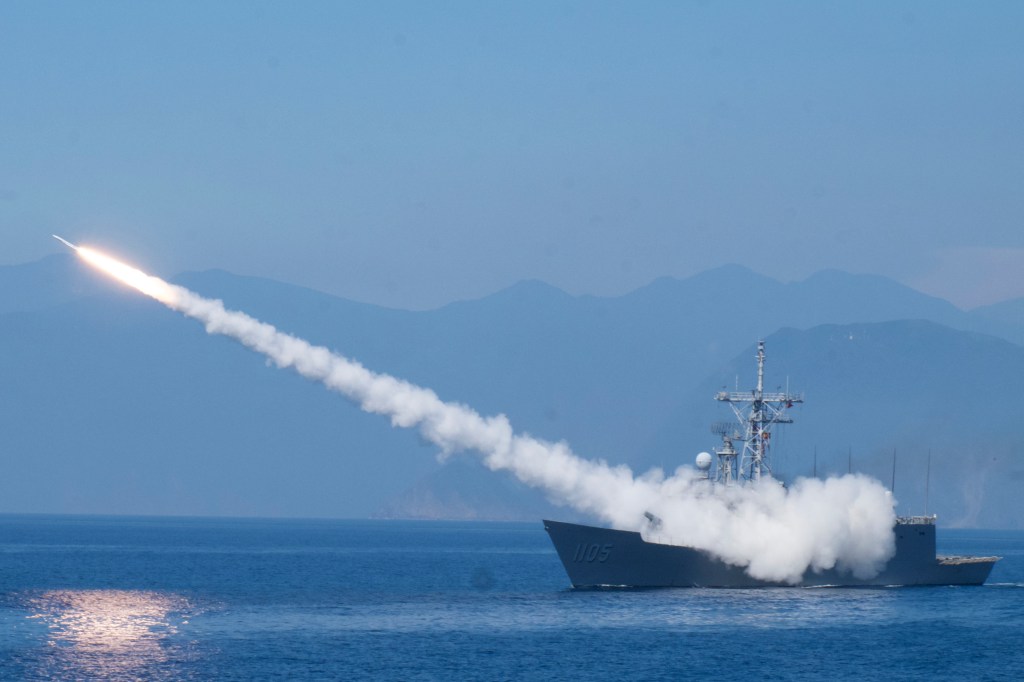
    Recent military exercises around Taiwan are increasing the risk of accidental war.

    Even worse, according to classified documents recently leaked by Air National Guardsman Jack Teixeira, “China’s intensifying military activity around Taiwan is undermining the intelligence community’s ability to accurately track what is normal and what is escalatory, raising the risk of accidents and miscalculation.”

    As Paul Rudd, Australia’s ambassador to the US, put it in The Avoidable War, it seems “less and less a question of if Beijing will have to handle the operational and diplomatic consequences of an unintended collision between Chinese, American, or Japanese military vessels or aircraft in the future, but when.” (Kindle loc 5809)

    As explained in my post “Avoiding a US-China war,” Rudd’s book contains numerous detailed suggestions to reduce the risk of war over Taiwan, accidental or intentional.  “First, the United States and China must both develop a clear understanding of the other’s irreducible strategic redlines in order to help prevent conflict through miscalculation,” Rudd wrote.  Then China and the US should “channel the burden of strategic rivalry into a competitive race to enhance their military, economic, and technological capabilities.”

    This great power rivalry is unlike any in past history, and not just because of the ultimate threat of nuclear war.  As Pulitzer Prize winning columnist Thomas Friedman wrote in the New York Times a few weeks ago: “Neither China nor America has ever had a rival quite like the other… [the two] nations have become as economically intertwined as the strands of a DNA molecule.”

    But these days, he continued “Relations between our two countries have soured so badly, so quickly… that we’re now like two giant gorillas looking at each other through a pinhole. Nothing good will come from this… [In fact], the smallest misstep by either side could ignite a U.S.-China war that would make Ukraine look like a neighborhood dust-up.”

    The hawkish statements now increasing in both China and in the US certainly aren’t helping.  In a self-fulfilling prophecy, the fear of war can actually increase its likelihood.  As one Rand consultant put it, “An exaggerated sense of danger can exacerbate tensions and aggravate perceptions of hostile intent.”  What we need is more communication, better communication, and a sense of calm.

    As to the question of inevitability, I agree with Friedman’s conclusion: “I don’t buy the argument that we are destined for war. I believe that we are doomed to compete with each other, doomed to cooperate with each other and doomed to find some way to balance the two. Otherwise we are both going to have a very bad 21st century.”

    The sheer stupidity of Nancy Pelosi’s trip to Taiwan

    Generally speaking, it’s not a good idea to poke a tiger in the eye with a stick.  Especially if the tiger is up for re-election. 

    But that’s essentially what US House Speaker Nancy Pelosi did on her trip to Taiwan on August 2.  In a few weeks, over 2,000 Communist Party delegates will meet in Beijing and select its leaders for the next five years at the CCP’s 20th National Congress.  Xi Jinping will almost certainly be re-elected to an unprecedented third term as President, but he and his political allies have been under pressure for some time due to the human and economic effects Xi’s “zero-COVID” policy, and continuing lockdowns of millions of citizens. 

    And as former Australian Prime Minister Kevin Rudd put it in his book The Avoidable War, “the ‘return’ of Taiwan remains the holy grail of Communist Party politics… many Americans may not appreciate how central the Taiwan question is to the CCP’s political priorities… or how much Taiwan shapes how China views its overall relationship with the United States.”  (Kindle loc 1534 and 1604 )

    It would have been hard for Pelosi to pick worse timing, or an issue more likely to further inflame China’s already rabid wolf warrior nationalist movement. And inflame it she did.  Hu Xijin, a former editor of the party-run tabloid Global Times, wrote that the Chinese military should ‘shoot down Pelosi’s plane.’”  Many Chinese thought they might, and nearly 3 million of them tracked the flight’s progress on the app Flightradar24 to see, making it “the most tracked flight of all time.”

    So what has Pelosi’s controversial visit accomplished so far?

    • Minutes after her plane landed on August 2, China announced four days of its most aggressive military exercises ever against Taiwan.
    • Almost as soon as Pelosi left, Chinese warships circled Taiwan, in part to demonstrate how easy it would be to cut the island off from the rest of the world.
    • On August 4, China launched 11 ballistic missiles in the area, some flying directly over Taiwan.
    • On August 5, Taiwan reported 68 Chinese warplanes over the Strait separating them from mainland China. 
    • Of these, 49 entered the disputed Air Defense Identification Zone, the midway point between China and Taiwan.  This came close to setting a new daily record.
    • Flights crossing the median continued at a rate of about 10-20 per day for several weeks.
    • According to a CNN report “Chinese and foreign analysts say the PLA’s cross-strait sorties aren’t likely to go away anytime soon, effectively making them a daily routine that some say could wear down Taiwanese vigilance as well as that of its supporters, including the US.”
    • In response to the heightened tensions, Taiwan has announced a record jump in defense spending for next year.
    • Cyberattacks against Taiwan have increased to rates 23 times higher than the previous daily record.
    • While military activities are setting new highs, US-China communication is approaching new lows.
    • China has canceled future phone calls and meetings between defense leaders in the two countries.
    • They have also canceled bilateral discussions on such topics as immigration, drug operations, and climate change.
    • This last is particularly disturbing. As US Secretary of State Antony Blinken put it “China’s decision to suspend climate talks ‘could have lasting consequences for the future of the region, the future of our planet,’ and would punish the developing world rather than the US.”
    An anti-American protest in response to Pelosi’s visit.

    Summing up these events and others, “the China Power Project at the US-based Center for Strategic and International Studies said Beijing ‘seeks to establish a new normal in which the PLA [People’s Liberation Army] no longer respects Taiwan’s claims to a separate airspace and territorial waters.’” Chinese commentators are using the same phrase “Military drills that simulate actual battles have become the new normal. China can now decide whether a future exercise will seamlessly be turned into actual combat.”

    So what could Pelosi have been thinking when she decided to include Taiwan on this Congressional Delegation trip to Asia?

    Pelosi had been asked to avoid Taiwan on this jaunt by a number of senior officials, including President Biden. According to a White House spokesperson, “The United States had seen indications over the last several months that China was considering unprecedented military activity across the Taiwan Strait, and officials had seen signs that China would use Pelosi’s visit as a pretext to act.”  Which of course, is exactly what they did.

    On July 28, Xi Jinping had even called Biden with a direct request: “Find a way to keep Pelosi from visiting.” Biden explained as a practical matter that would be difficult or impossible to accomplish.  That’s not how we do things in the US.

    Pelosi explained her reasons in a Washington Post op-ed published the same day she landed in Taiwan: “The CCP’s brutal crackdown against Hong Kong… cast the promises of ‘one-country, two-systems’ into the dustbin…  By traveling to Taiwan, we honor our commitment to democracy.” 

    It is worth noting that Pelosi’s op-ed does not seem consistent with official US State Department policy, which still holds to the principle of “strategic ambiguity.”  As explained in the New York Times, this “longstanding — and famously convoluted — policy [is] derived from America’s ‘one China’ stance that supports Taiwan without recognizing it as independent.  The United States provides political and military support for Taiwan but does not explicitly promise to defend it from a Chinese attack.”

    An opposing opinion piece published the same day in the Washington Post was entitled “The real crisis over Taiwan will start after Pelosi comes home.”  It predicted that “The pace and intensity of U.S.-China competition are set to go up, changing the relationship forever, with Taiwan caught squarely in the middle.”

    Writing a few weeks after Pelosi’s visit, two experts from the Carnegie Endowment provided several examples of how this prediction was already becoming true.  “Beijing could use an American freedom of navigation operation as a pretext to escalate the crisis further, potentially leading to an unsafe incident or encounter at sea or in the air. The breakdown in bilateral communication channels and the broader distrust between the United States and China only makes such a contingency more likely. Recent reports indicate that U.S. Secretary of Defense Lloyd Austin was unable to reach his Chinese counterparts after Beijing suspended multiple military deconfliction protocols.”

    And just a few days before this blog was posted, “Taiwan… shot down an unidentified civilian drone over one of its islands that lies just a few kilometers from mainland China.”  Uh oh.

    Pelosi is entitled to her opinions, of course.  But you’d hope a highly successful 82 year old politician could find something better to do with her time than rattling her saber. 

    A number of analysts have offered a cynical view of her motives, including Ian Bremmer, the president of Eurasia Group, who said Pelosi “had wanted to visit Taiwan before her retirement as part of her personal legacy.”  

    It would be a shame for all of us if this is even partly true, and one congress member’s hubris ultimately helped lead to an accidental war.

    The Taiwan conundrum

    Beijing is irrevocably committed to regaining control of Taiwan, an island about 100 miles off China’s coast.  But the US and its allies are committed to the opposite:  helping Taiwan maintain its status as an independent county.  Something’s got to give. 

    To put the problem in context, Taiwan was part of China for over 200 years, until it was ceded to Japan in 1895 when China lost the first Sino-Japanese War.    Taiwan was returned to China at the end of World War II, but then taken over by the Nationalist Chinese forces after they lost their civil war to the Communist Party in 1949.    

    As recently as a few weeks ago, Chinese Foreign Ministry spokesman Zhao Lijian told reporters that: “China’s position on the Taiwan question is consistent and clear. There is but one China in the world, and Taiwan is an inalienable part of China’s territory.”  

    Zhao is certainly correct that the Chinese have been both consistent and clear.  Nearly 50 years ago, when President Nixon visited China in 1972 to reopen relations between the two countries, Chinese Premier Zhou Enlai’s “principal goal was to persuade [US Secretary of State Henry] Kissinger to agree to ‘recognize the PRC as the sole legitimate government in China’ and ‘Taiwan Province’ as ‘an inalienable part of Chinese territory which must be restored to the motherland.’”

    In 2019, on the 40th anniversary of the US establishing diplomatic relations with China, President Xi Jinping gave a speech explaining how the need for re-unification with Taiwan remains critical. Xi also emphasized the need for a peaceful solution, repeating a line from a 1995 speech by former Chinese president Jiang Zemin that “Chinese will not fight Chinese.” But Xi also went on to say that Beijing ultimately “reserves the option to take any necessary measure,” and that the problem “should not be passed down generation after generation.”

    Xi described the re-unification of Taiwan as part of the “great rejuvenation of the Chinese nation,” a phrase often used when referring to China’s “century of humiliation” at the hands of foreign powers, and its current rise to true superpower status. As a New York Times article summed up the situation a few weeks ago, “to Beijing, Taiwan continues to be a source of embarrassment, the island where the losers in the country’s civil war fled in 1949 and whose government is propped up by foreign powers.”

    In his provocative book Has China Won? (p. 94), former president of the UN Security Council Kishore Mahbubani concluded that “the one issue where the Chinese leaders cannot bend and compromise is Taiwan… [this issue could even] trigger a war.”

    The American position is quite a bit muddier.  In 1979 Congress passed the Taiwan Relations Act which stated in part that the U.S. will consider “any effort to determine the future of Taiwan by other than peaceful means, including by boycotts or embargoes, a threat to the peace and security of the Western Pacific area and of grave concern to the United States.” 

    More recently, in one of his fist major speeches on China, Secretary of State Antony Blinken has warned that “when China uses coercion or aggression to get its way… We will push back if necessary.” 

    Both statements are consistent with the US’ longstanding policy of “strategic ambiguity.”  As a New York Times article recently explained “Under a longstanding — and famously convoluted — policy derived from America’s ‘one China’ stance that supports Taiwan without recognizing it as independent, the United States provides political and military support for Taiwan, but does not explicitly promise to defend it from a Chinese attack.”

    So, to sum it up, if China takes aggressive action on Taiwan, the US will consider it a matter of “grave concern” and we will push back “if necessary.”  Any questions?

    I suspect that nobody knows exactly what the US would do in response to a direct threat to Taiwan, not even in Washington.

    When the Senate Armed Services Committee recently reviewed the nomination of Adm. John Aquilino to lead the US military’s Indo-Pacific Command, one Senator asked was why the US should defend Taiwan at all.  Aquilino replied that “Washington’s credibility as an ally to places like Japan and the Philippines is at stake if the island were to fall to Beijing.”

    In a Bloomberg opinion column ominously titled “A Taiwan Crisis May Mark the End of the American Empire” Niall Ferguson added several other reasons, notably that “Taiwan in recent years has also gained a greater strategic importance as one of the world’s leading producers of semiconductors — the high-tech equivalent of oil in the emerging supercomputing showdown between the United States and China, which faces microchip supply shortages.”

    An article in Asia Times about the microchip shortage noted cynically that the US used to be a leader in “all forms of high tech, especially semiconductor chips, [but] now spends its time redesigning chocolate chips.”  Meanwhile, the Taiwan Semiconductor Manufacturing Company (TSMC) has become “pretty much the only place to get processor chips fabricated, unless you’re Intel.” 

    Often missing from discussions of this diplomatic stalemate is a discussion of what the 24 million people who live on Taiwan want.  This is unfortunate since “it is the people of Taiwan who will suffer if American actions provoke military responses from China.”  (Has China Won, p. 98)

    One way to answer this question is to look at the results of Taiwan’s most recent presidential election. “Taiwanese President Tsai Ing-wen won a landslide election last year on a promise of defending the island’s democracy and standing up to China.”  The Unionist Party, which favors re-unification with the mainland, got just 0.23 percent of the vote. 

    The implication is obvious, according to Taiwan News: “the majority of Taiwanese do not believe Communist China can peacefully coexist with a free society, and voters rejected China’s ‘one country, two systems’ framework by casting a vote for the presidential candidate who opposes it.”

    A few weeks ago, Taiwan’s foreign minister said that if China attacks “We will fight a war if we need to fight a war, and if we need to defend ourselves to the very last day, then we will defend ourselves to the very last day.”

    What are the chances of winning?  One way of estimating this, and of refining military strategy, is to look at the results of simulated war games conducted by military officers.  According to David Ochmanek, a former senior Defense Department official who helps run war games for the Pentagon “the results are sobering and the United States often loses.”   In an article in Foreign Affairs, Fareed Zakaria was more specific “The Pentagon has reportedly enacted 18 war games against China over Taiwan, and China has prevailed in every one.”  Hmm.

    And therein lies the conundrum:  What should the US do?  And when?

    If Hu Jintao (President 2003-2013) or Jiang Zemin (President 1993-2003) or any of China’s other recent leaders were in power, I believe that they would try to bring Taiwan under control the same way that they gained control over Hong Kong, patiently and without major violence.  As Chinese general Sun Tzu wrote in The Art of War in the 5th century BC, “The supreme art of war is to subdue the enemy without fighting.”  The result has been, in the words of the Washington Post “Hong Kong’s fall from a relatively free, boisterous territory to an Orwellian place that resembles the repressive mainland.”

    But current president Xi Jinping may be on a faster, more aggressive path with Taiwan.

    Interestingly, Niall Ferguson has reported that, “I was told by one of Xi’s economic advisers that bringing Taiwan back under the mainland’s control was his president’s most cherished objective— and the reason [Xi] had secured an end to the rule that had confined previous Chinese presidents to two terms.” 

    Since January, China has significantly increased flights of military aircraft violating Taiwan’s airspace, in “attempts to intimidate” the Taiwanese government.  Two weeks ago, China “conducted simultaneous military exercises to the west and east of Taiwan… [which] showed that the People’s Liberation Army is capable of surrounding the island of Taiwan, isolating its troops and leaving them nowhere to run and no chance to win.”

    The clock is ticking.  When Adm. Philip Davidson, commander of the U.S. Indo-Pacific Command, was asked by the Senate Armed Services Committee about timing he replied that “The threat is manifest during this decade, in fact, in the next six years.”

    Similarly, a New York Times article two weeks ago entitled The New Taiwan Tensions quoted Anne Applebaum of The Atlantic “that a Chinese invasion ‘could happen at any moment.’”  

    The article’s conclusion was a bit more optimistic: “a military conflict still seems unlikely. Then again, military conflicts often seem unlikely until the moment they begin.”