How rich Is Xi Jinping?

Exactly how rich is the President of the People’s Republic of China?  According to an April 2024 Congressional Research Service report based on public records: “Xi Jinping holds an estimated hidden wealth of $700 million.”  But wait.  Nobody really knows if this is correct.  Other published estimates place Xi’s total worth as high as $1.2 billion or as low as $1 million.

That’s quite a range:  the highest of these three estimates is 120,000 times larger than the lowest.  What’s behind this enormous disagreement?  Secrecy.

The estimates above refer to family wealth, not personal wealth.  That’s because in China, “generally the big corruption does not happen with the officials themselves, but with relatives of officials. Just being related to a big-wig means that people will throw money at you.”  Then add the fact that “Much of the family’s wealth remains unclear and untallied because of the absence of Chinese corporate and real estate disclosure rules, as well as a propaganda system that bans media discussion of leaders’ personal details and removes them from the internet.”

For example, around the time Xi first became China’s President, Bloomberg News journalist Michael Forsythe published an expose regarding Xi’s wealth.  Soon after “Forsythe and his family received death threats, and Bloomberg’s site was blocked within [China].”  This intimidation worked.  As a result of the reaction to Forsythe’s piece, “Bloomberg declined to publish a subsequent investigation…”

Despite the difficulty of coming up with a reliable total figure, it is very clear that Xi lives a VERY comfortable life, including:

Also note that in China, “for very high ranking officials [in China], all things for their entire life are provided by the government… [and they] do not have much opportunity to use their own money” for living expenses.  But the world is full of luxuries and many Chinese leaders and their families don’t seem to have trouble finding things to spend their excess money on. 

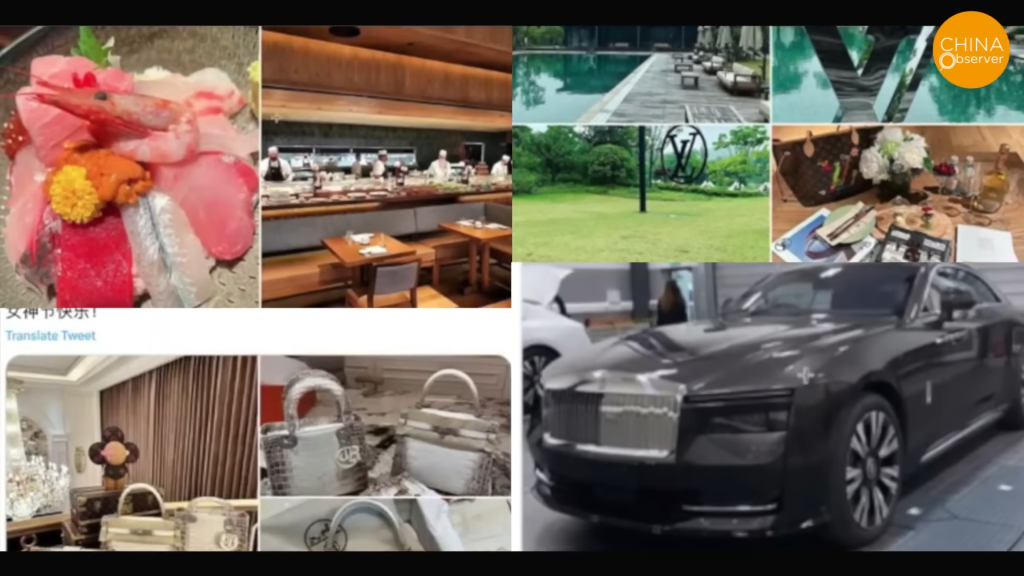
Some examples can be seen in a Twitter account started in 2022 by Xi’s only child — his 32 year old daughter Xi Mingze (nicknamed Xiao Muzi) — showcasing her lavish lifestyle including:

  • A Van Cleef &  Arpels’ bracelet valued at over $135 thousand (US)
  • A custom Patek Philippe diamond watch worth $1 million (US).  (Normally, this particular watch is reserved for VIPs who spend over $5 million annually on this brand.)
  • A customized Rolls-Royce Cullinan worth $28 million (US)
  •  $100 million (US) mansion in Hong Kong
  • And much more
In 2022 Xi Mingze – Xi Jinping’s only child – posted these images to a Twitter account illustrating her luxurious lifestyle.  In 2023, they were deleted from the internet.

But Xi Mingze’s posts on luxuries ended “on September 25th 2023 when her Twitter account was exposed by Luda media.”  As a result, Xi Mingze “allegedly [issued] a death threat against Luda media indicating that any harm coming to the media network would be her family’s doing.”

Some US politicians seem to believe that if the facts become available “about the enormous wealth of individual leaders of the CCP, the Chinese people will turn China into a respected democracy like Taiwan.” 

For example, “Sen. Marco Rubio inserted language into… the 2023 National Defense Authorization Act… which required the US Director of National Intelligence to produce a ‘Report on the Wealth and Corrupt Activities of the Leadership of the CCP’” by December 2023.  The report would investigate not just “Xi Jinping… [but also] other members of the Central Committee, the Politburo, the Politburo Standing Committee, and regional Party Secretaries.”

Interestingly, as of the date of this post — 10 months after the publication deadline had passed — the report yet to be published.  My personal guess is that Avril Hines – Director of National Intelligence – is slow walking the report, at least until after the Presidential election. 

If all of the info on Communist leaders’ wealth was fully vetted by US intelligence, and released as part of a well-thought out strategy to manage the contentious US-China relationship, perhaps it might make a difference.  But in this case it feels more like an isolated action poking Xi Jinping in the eye with a stick, to show the world that we’re right and he’s wrong.  In my opinion, Cruz and his allies range from naïve to downright stupid if they really think that such a report would convince Chinese citizens that they would be better off in a Taiwan-style democracy. 

When (or if) this report is published, it will almost certainly prove that Xi is just one of many leaders who live luxurious lifestyles on the backs of the Chinese people.  In fact, Xi’s offenses are likely to be relatively modest compared to some others.  Since coming to power in 2012, Xi has focused on anti-corruption campaigns and earlier this year, he vowed to intensify this campaign and “target industries such as finance, energy and infrastructure.”

Corruption is a long-standing tradition in China, going back thousands of years, at least to Qin Shi Huang, the first Chinese emperor in 259 BCE.    

After the Chinese Communist Party won its revolution in 1949, many Party leaders lived the high life.  Numerous examples appear in the controversial book “The Private Life of Chairman Mao,” written by Mao’s long-term personal physician Li Zhisui, including:

  • “Luxuries not even imaginable to the Chinese citizenry, [such as] owning numerous estates, and having numerous extramarital affairs with very young women and even boys”
  • “Like Chinese emperors of antiquity, Mao believed that regular sex ensured a long life and had at least 3,000 concubines over his lifetime… He aimed to have sex with a different virgin girl every night.
  • He was also “a gourmet… [whose] favorite foods were flown to Beijing from all over the country, including a special kind of fish [that needed to be] kept alive in a plastic bag filled with water and accompanied by a servant responsible for administering oxygen.

I don’t know about you, but it feels more than a little odd to me that the heads of the largest Communist nation on Earth would have access to privileges denied China’s 1.4 billion residents.

When Karl Marx and Friedrich Engels published the Communist Manifesto in 1848, they focused on “the exploitation of the proletariat (working class of wage laborers) by the ruling bourgeoisie.”  They did not mention the possibility that the success of the Communist Party could create a new class of leaders who would exploit the proletariat.

In 1887, English historian Lord Acton wrote “Power tends to corrupt, and absolute power corrupts absolutely.”  It’s still true.

So, in my opinion, the fact that many of China’s leaders are rich while more than a billion of its citizens are poor is not surprising.  The fundamental causes lie not in communism or in capitalism, but in human nature. 

The possible role of human nature in inequality will be the basis for a number of posts in my soon to be updated “other blog”:  Understanding US economic inequality, five minutes at a time.
Chinese espionage

The Chinese are spying on us.  Which seems only fair, since we are spying on them too.

You probably remember last year’s journalism hysteria when a Chinese surveillance balloon floated over the US, and the Air Force shot it down off the cost of South Carolina.  In the big picture, that was a mere kerfuffle, a foofaraw. 

But don’t be fooled.  Chinese espionage offers plenty to be worried about.  In a 2020 speech, FBI Director Chris Wray called “the counterintelligence and economic espionage threat from China… the greatest long-term threat to our nation’s information and intellectual property, and to our economic vitality.”

Since 2020, it’s only gotten worse.  Last October, the heads of intelligence from the US, Canada, UK, Australia and New Zealand – the Five Eyes Alliance – held “an unprecedented joint news conference to warn of… a ‘breathtaking’ Chinese effort to steal technology and economic intelligence and to influence foreign politics in Beijing’s favor.”  According to the FBI’s Wray,  the purpose of this first press conference in the organization’s 80 year history was to warn that the threat from “China’s espionage…  has only gotten more dangerous and more insidious in recent years… The FBI currently has over 2,000 investigations in progress that are linked to China.”

At the same conference, Ken McCallum, the Director General of Britain’s MI5 spy agency reported several examples of his own, including the fact that “suspected Chinese agents have approached over 20,000 people in the UK over professional networking sites like LinkedIn, in order to try to cultivate them to provide sensitive information.”

There are two main reasons why it is very difficult for the West to keep up:  China devotes more resources to espionage, and they are playing by different rules than we are.

Regarding resources, Wray testified before a US House committee on January 31 that, “If you took every single one of the FBI’s cyber agents [and] intelligence analysts and focused them exclusively on the China threat, China’s hackers would still outnumber FBI cyber personnel by at least 50 to 1.”

Chinese hackers work not just as government employees, but also for private Chinese companies that specialize in spying.  A few weeks ago, leaked documents from the Chinese security firm I-Soon recently revealed a price list of what they charged.  If you want to hack Twittter/X accounts and run a disinformation campaign, for $100,000 I-Soon will sell you specialized software to make your targeting and lying more efficient.  Do you want a huge database of personal information entered by unwitting users of Facebook and Telegram?  For $278,000 that too can be yours.

In addition to devoting greater resources to espionage, China’s authoritarian government is also playing by different rules.  Harvard’s Calder Walton summarized key differences in a recent article in Foreign Policy magazine:  “Unlike those in Western democracies, China’s intelligence services are not held to account by independent political bodies or the public, nor are they subject to the rule of law… Thanks to successive national security legislation passed under President Xi Jinping, Chinese businesses are required to work with its intelligence services whenever requested to do so… [In addition] facial recognition, phone apps, and CCTV all make China an infinitely harder target for Western agencies to collect intelligence on than Chinese services’ targets in open Western democracies.”

And if that’s not enough, according to David Vigneault, the director of the Canadian Security Intelligence Service, Chinese laws require its citizens “anywhere in the world to provide information to Beijing’s intelligence services.”

Just a few weeks ago, the FBI’s Wray updated Congress on one major cyber operation which he described as part of “the defining threat of our generation.”  In the Volt Typhoon project “Chinese hackers [have targeted] critical infrastructure in the U.S., such as water treatment plants, electrical grids, oil and natural gas pipelines and transportation systems.” 

The result of operations like Volt Typhoon, according to Congressional testimony by Jen Easterly, Director of the US Cybersecurity and Infrastructure Security Agency, is that “A major crisis halfway across the planet could well endanger the lives of Americans here at home through the disruption of our pipelines, the severing of our telecommunications, the pollution of our water facilities, the crippling of our transportation modes all to ensure that they can incite societal panic and chaos and to deter our ability to marshal military might and civilian will.”

Your home network could be unwittingly aiding a massive Chinese espionage operation, if your router has been infected by KV Botnet malware.   

The primary methods behind this particular operation relied on human flaws “by exploiting vulnerabilities in small and end-of-life routers, firewalls and virtual private networks, often using administrator credentials and stolen passwords, or taking advantage of outmoded tech that hasn’t had regular security updates – key weaknesses identified in US digital infrastructure.”

If you have an old Cisco or Netgear router running your home or small business network, it may have been infected by “KV Botnet malware” planted by the Chinese. If so, your router was “chained together [with other infected routers] to form a covert data transfer network supporting various Chinese state-sponsored actors including Volt Typhoon.”  

Yikes.  Your innocuous little home network could be helping the Chinese to hide the origin of an infrastructure attack someday, since “the botnet’s distributed nature makes the activity hard to trace.”  This is a prime example of the way “state-sponsored cyber actors are seeking to pre-position themselves on IT networks for disruptive… cyberattacks against US critical infrastructure in the event of a major crisis.”

In December, the FBI fought back with a court-ordered action to “delete the KV Botnet malware from the routers.”  But if you restarted your router after the cleanup, your server will once again be vulnerable.  This is one of several reasons that experts say “the legal action is bound to be a only temporary disruption.”

To put it another way, the potential effects of Chinese espionage continue to rise.

In an article entitled “Spycraft and Statecraft,” William J. Burns, the director of the Central Intelligence Agency wrote in the current issue of Foreign Affairs that “This is a time of historic challenges for the CIA and the entire intelligence profession, with geopolitical and technological shifts posing as big a test as we’ve ever faced. Success will depend on…  adapting to a world where the only safe prediction about change is that it will accelerate.”

To address the China challenge, Burns reported that the CIA has more than doubled “the percentage of our overall budget focused on China over just the last two years. We’re hiring and training more Mandarin speakers while stepping up efforts across the world to compete with China, from Latin America to Africa to the Indo-Pacific.”  The New York Times reported that, “The C.I.A. and the Pentagon’s Defense Intelligence Agency have [also] set up new centers focused on spying on China. U.S. officials have honed their capabilities to intercept electronic communications, including using spy planes off China’s coast.”

Meanwhile, the American and Chinese economies continue to get more intertwined.  At the height of the Covid epidemic, many Americans learned for the first time that the US depends on China for things like surgical masks, personal protective equipment, respirators and many other medical products needed to fight the disease.  In the early stages of the pandemic, when world supplies were short, China wouldn’t share them.

The top ten products the US imports from China today include lithium batteries, display monitors, smartphones, digital automation systems, pre-dosed medications and data processors.  Good luck to all of us if access to these and other Chinese products was cut off during a crisis.

So, at the same time that we continue to compete with China politically and economically, we must simultaneously cooperate and work together to tackle existential challenges to the human race including climate change and avoiding nuclear war.

Last year, Pulitzer Prize winning reporter Thomas L. Friedman visited China for the first time since covid to try to get a grip on what all this means.  Hu Xijin, one of China’s most popular bloggers, said to him: “You have been in the first place for a century, and now China is rising, and we have the potential to become the first — and that is not easy for you… [But] you should not try to stop China’s development. You can’t contain China in the end. We are quite smart. And very diligent. We work very hard. And we have 1.4 billion people.”

Based on this and many other interviews, Friedman concluded: “I believe that [China and the US] are doomed to compete with each other, doomed to cooperate with each other and doomed to find some way to balance the two. Otherwise we are both going to have a very bad 21st century.”