
For thousands of years in China, the elderly were held in great esteem for their knowledge, and expected to guide future generations by passing along their hard earned wisdom. This is based in part on the Confucian principle of filial piety which requires not just respect and care for the older generation, but also an almost unthinking obedience to their authority.
This post updates my 2021 piece How families are changing which described how long-standing customs were being challenged by industrialization and urbanization. A social structure built for a rural society with stable extended families living together was overturned when hundreds of millions of young people moved to newly built cities, to take advantage of the opportunities of China’s rapidly growing economy.
As an article in the Journal of Comparative Family Studies noted, the changes in China family structure reflect worldwide trends related to industrialization. “Modernization impacts family structure, relationship, values and beliefs. Families become nuclear while people become mobile and the society becomes urban. Economic development provides employment opportunities outside the birthplace.”
The effects on families were magnified in China by its ill-advised “One Child Policy.” Beginning in 1979, the government attempted to reduce population growth by limiting each family to a single child through financial incentives and penalties, including loss of employment, and even forced abortions and sterilization. This unpopular policy worked so well that the percentage of the population young enough to work shrank, while the percentage of old people grew. People began talking about the “4-2-1 problem,” with four grandparents and two parents supported by one working-age adult.
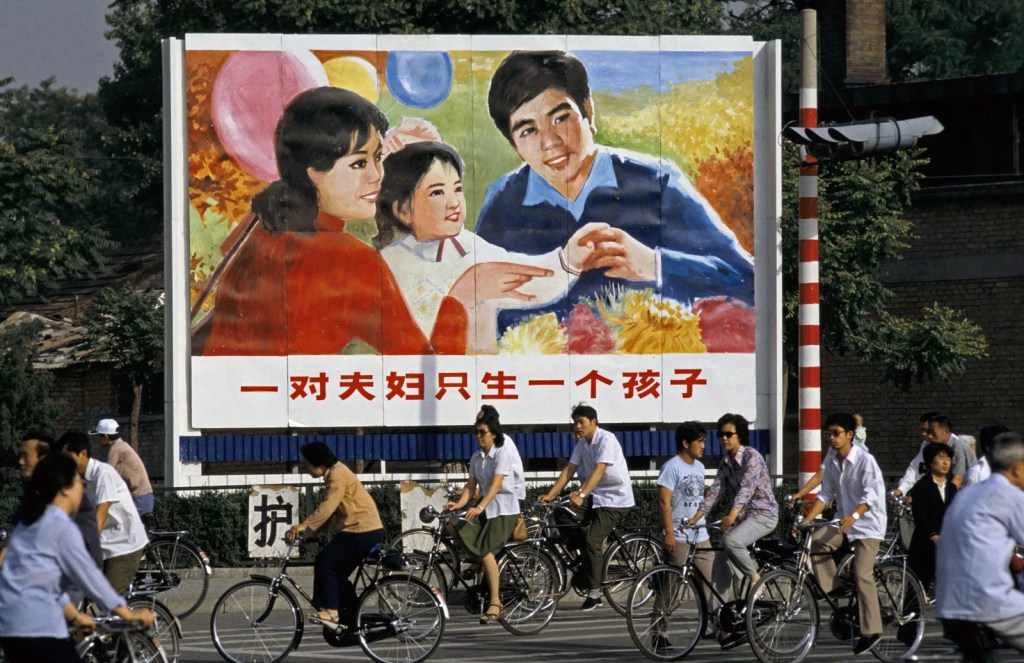
It took 37 years for the central government to respond to the problem and change the law to the Two Child Policy in 2016. When that didn’t work, they went to the Three Child Policy, which is still in effect. But the harm had already been done, as the number of working age adults has declined and the percentage of elderly non-laborers has exploded.
The average family size in China decreased from 3.4 in 2000 to 2.6 in 2020, and the number of single persons living alone doubled between 2010 and 2020, to 8.9% of all households. Disruptions to the traditional family were magnified when women increasingly entered the labor force. They now represent about 45% of China’s workers.
One unintended side effect was that “Soon after China implemented its one-child policy in 1979, reports reached the West of a new breed of plump, pampered creatures who had never learned to share. They were called Little Emperors, and nobody said ‘No’ to them.”
Social scientists who have studied the Little Emperor Syndrome describe such effects as egocentrism, selfishness, poor social skills, spoiled behavior, and a low tolerance for frustration. As an article in the UK newspaper The Guardian summed it up: “It was as if Britain had decided to spawn millions of Prince Andrews.” (That’s not a good thing. In case you don’t follow the fortunes of the House of Windsor, a few weeks ago Prince Andrew was formally stripped of his royal titles due to his associations with convicted sex offender Jeffrey Epstein.)
But life is not all a bed of roses according to an article in the South China Morning Post entitled Little emperors to little slaves. The 4-2-1 problem implies that many elders’ security ultimately depends on the financial success of a single working adult. According to one Chinese teenager quoted in The Guardian article, “Our parents sometimes do lots of things that we should be doing for ourselves because they want us to concentrate on our grades. For instance, my mom pushes my bike out of the door, presses the elevator button and waits for me to finish my breakfast and go out. It’s just study, study, study, study and nothing else.”
Another described working on grades 14 hours a day: “We wake up at 6:30 AM. We don’t have enough hours to eat: I skip my dinners for homework.” Parental standards are high. “ It is common… to score 100% in a school test, then be urged to try harder next time.”
These standards are reinforced by China’s cultural emphasis on education as the key to success, as I explained a few years ago in a post entitled: Do children in China study harder than Americans? The short answer is: yes they do. By a lot.
One 22 year old summed the consequences up like this: “It’s a huge burden for us, to take care of our mother and father. At our age, you have to start thinking about that. When I get married, my wife and I will have to take care of four old people, so I am deliberately screening out certain jobs already.”
And for young adults who don’t succeed in school and get a good job, the result is public failure. According to Peng Zizhe, director of the Institute of Population Research at Shanghai’s Fudan University “it is not uncommon for people in their late 20s still to be living like children with their parents. They still get enough love from their mothers, so they don’t need to create a solid marriage unit.”
If a parent loses their only child, it’s called the shidu parent tragedy because it leaves no one to support the elderly person. What makes it a tragedy is the fact that China lacks the types of safety nets provided by Social Security and other systems in the US.
A related change involves shifts “in the form of filial behavior. With more adult children working longer hours, living at a distance, or focusing on their own nuclear families, filial piety increasingly emphasizes financial support, frequent communication and occasional visits rather than full-time caregiver co-residence or daily obedience.”
Some experts on Chinese family structure now talk about two different types of filial piety: the traditional duty based authoritarian model, and a more modern transactional model is built on “emotional attachments and intimate relations,” often referred to by the Mandarin word qinqing.”
A lengthy article in The Journal of Chinese Sociology by Yunxiang Yan reviews the way these sociological changes “are altering the ethical foundation of eldercare” by making a family’s history of qinqing the basis for how they treat their elderly parents. In this view, family history becomes sort of a qinqing balance sheet. What children will do for their parents in old age is based on how the parents treated them growing up.
The paper includes several case studies illustrating how this works, including one Mr. Guan, a widower in his 80s who complained at length “about his poor health, his unlucky fate, and how much he was suffering from his unfilial children.” But when the researchers talked to other villagers, they learned Guan had a long history of “beating up his wife and children” and favoring one child over the others. In the eyes of his neighbors, Guan got what he deserved. He “had not paid attention to qinqing, so no one in his family looked after him in his old age.” More generally, “family history and memories of individual experiences… may determine the quality of familial eldercare and its social sanctions by public opinion.”
Given all these changes, in 1996, the Eighth National People’s Congress adopted a 50 article law on the “Protection of the Rights and Interests of the Elderly.” It required children to support their parents after the age of 59, including paying for medical care, providing nursing care, assuring proper housing and “not compelling the elderly to move to inferior houses.” In rural areas, grown children also had a “duty to help farm the land… and take care of trees and livestock” with all earnings going to the elderly.
Most importantly, this law gave the elderly the right to “bring a lawsuit directly to a People’s Court… when [they] have disputes with their family members over their support, or over housing or property.”
You can imagine how well that went. Over time, the law was supplemented by “family support agreements,” voluntary contracts signed by parents and children which can be legally enforced. However, a 2011 study found that these agreements actually “harmed relationships and led to more family lawsuits, suggesting that authoritarian methods may not be effective in sustaining filial relations.”
Yue Du’s 2023 book State and Family in China described how the Chinese government has repeatedly tried to rely on filial duty as a low-cost solution to the growing problem of an aging population. There’s just one problem: it doesn’t work. My reaction to this fact mirrors that of Captain Renault in the 1942 film Casablanca: “I am shocked. Shocked I tell you.”
The lack of a Social Security type safety net, and the failure of alternatives, is one reason a New York Times article described China’s aging population as a “looming crisis” and Time magazine called it China’s “number one economic problem.” For more on the implications, see my post entitled: Will China grow old before it grows rich?
 Understanding China, five minutes at a time